
Italy 1990: Germany's Third Title — and the Night Nessun Dorma Played
A substitute who became the tournament's top scorer. A goalkeeper who saved penalties like a man possessed. A final decided by the most controversial penalty of the decade. Italy 1990 was dramatic, often ugly — and utterly unforgettable.
The 14th FIFA World Cup was held in Italy from 8 June to 8 July 1990. The host nation were among the favourites alongside West Germany, Argentina, Brazil and the Netherlands — whose star-studded AC Milan trio of Van Basten, Gullit and Rijkaard arrived as one of the most anticipated forces of the tournament, only to become its biggest collective disappointment.
Italy themselves were solid rather than spectacular — outstanding defensively and in midfield, but uncertain in attack. Their unexpected hero emerged from the substitutes' bench: Salvatore Schillaci, barely considered a first-choice player at the start of the tournament, scored in every match he played and captured the imagination of Italian football with an intensity that felt almost too good to be true.
The tournament's great story, however, belonged to Cameroon. The Africans stunned the opening match by beating defending champions Argentina, then eliminated a strong Romania side before dramatically dispatching Colombia in the round of 16 — aided in no small part by Colombian goalkeeper René Higuita, who wandered so far from his goal to attempt a dribble past veteran Roger Milla that he was immediately punished with a goal that ended his side's campaign.
Argentina's meeting with Brazil in Turin was one of the finest matches of the tournament. Goalkeeper Sergio Goycochea was inspired, the woodwork helped him on several occasions, and the decisive moment came when Maradona drove from midfield and slipped a perfectly weighted pass to Caniggia, who finished coolly past Taffarel. That same evening in Milan, West Germany eliminated the Netherlands — revenge for their Euro 1988 defeat — in a match remembered as much for Frank Rijkaard spitting at Rudi Völler as for the football.
Both semi-finals went to penalties. Italy against Argentina in Naples, and England against West Germany in Turin — two nights of drama that gripped the world. Italy's exit on home soil was devastating for the host nation. England came closer to something significant than they had since 1966, only to fall short from the spot. The third-place match between Italy and England was, by common agreement, a more worthy final than what actually followed.
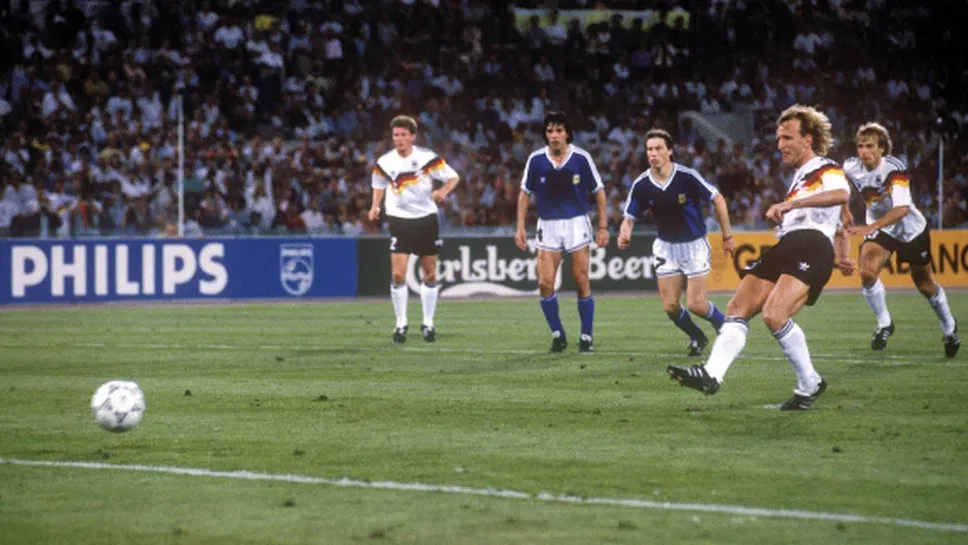
The final between West Germany and Argentina was a dour, cautious affair — a far cry from their 1986 encounter in Mexico. Chances were scarce on both sides until the 84th minute, when a disputed penalty was awarded after Völler went down in the area. Regular penalty taker Lothar Matthäus declined to take it, citing a problem with his boot. Andreas Brehme stepped up instead and converted — and West Germany were world champions for the third time. Franz Beckenbauer, lifting the trophy as coach, became only the second man after Mário Zagallo to win the World Cup as both player and manager.
Top scorer: Salvatore Schillaci (Italy) — 6 goals
Champions squad: Illgner, Brehme, Kohler, Augenthaler, Buchwald, Littbarski, Hässler, Völler, Matthäus, Klinsmann, Berthold, Aumann, Köpke, Reuter, Mill, Riedle, Bein, Steiner, Möller, Pflügler, Thon, Herrmann
Coach: Franz Beckenbauer
Highest-scoring matches: USA v Czechoslovakia 1-5, West Germany v UAE 5-1
Total goals scored: 115 | Average per match: 2.21
Best-attended match: 74,765 — Yugoslavia v West Germany | Average attendance: 48,391