
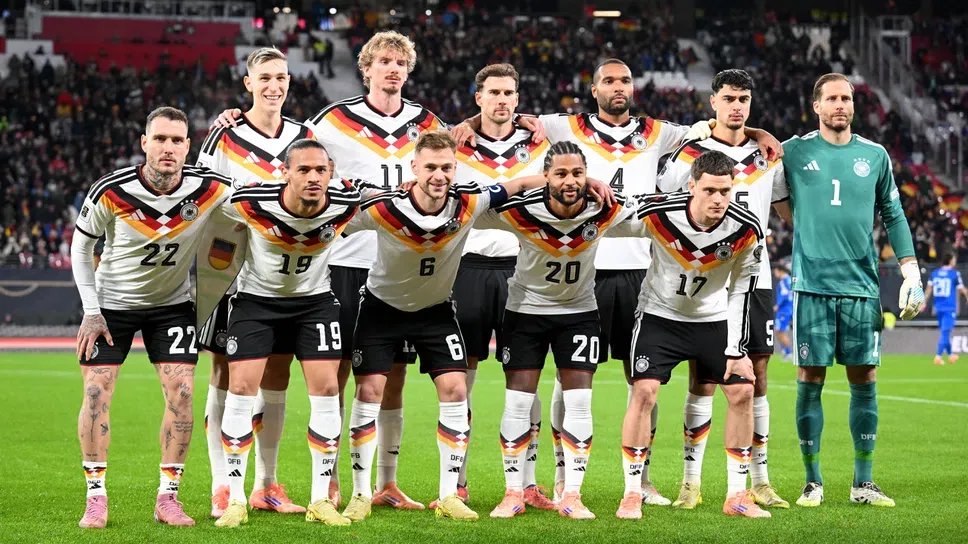
Germany at the 2026 FIFA World Cup: Squad, Manager, Fixtures & Tournament History
Four-time world champions with a record haul of quarter-final appearances, Germany arrive at 2026 under their youngest-ever coach with a point to prove — back-to-back group-stage exits have sharpened the hunger, and Nagelsmann's side are ready to remind the world what they're capable of.
Germany are back — and with something to prove. The FIFA World Cup 2026™ in Canada, Mexico and the United States marks their 21st appearance at the tournament overall and their 19th in a row, a streak that underlines their status as one of international football's most enduring forces. Four-time world champions, holders of the record for the most quarter-final appearances in World Cup history — yet they have failed to make it out of the group stage in each of the last two editions.
Julian Nagelsmann's side arrive in North America in transition, rebuilding after two painful early exits, and determined to remind the world what German football is capable of.
The Coach: Julian Nagelsmann
At 38, Nagelsmann is the youngest manager in German football history — and one of the most tactically sophisticated of his generation. He was brought in to replace Hansi Flick in September 2023, inheriting the role with barely enough time to prepare for UEFA EURO 2024 on home soil. Initially appointed on a short-term basis, he extended his deal before the tournament began and has since signed a third contract with the German Football Association (DFB), keeping him in charge through UEFA EURO 2028.
His club career brought success at Hoffenheim, RB Leipzig and Bayern Munich, where he became known for building teams of considerable tactical flexibility. With Germany, he has leaned towards a controlled, high-pressing approach — one that prioritises defensive structure and purposeful transitions over the more risk-tolerant possession style of his predecessor. The squad is still evolving, but the foundations are taking shape.
Germany's 2026 World Cup Fixtures & Group
14 June: Germany v Curaçao – Houston Stadium
20 June: Germany v Côte d'Ivoire – Toronto Stadium
25 June: Ecuador v Germany – New York New Jersey Stadium
How Germany Qualified
Germany sealed their place at the 2026 finals in their final qualifying match in November 2025, finishing top of Group A ahead of Slovakia, Northern Ireland and Luxembourg. Five wins from six games, 16 goals scored and only three conceded tells the story of a group they ultimately dominated — though it wasn't without turbulence. A shock 2-0 opening defeat in Bratislava threatened to derail the campaign before it had started, but Germany recovered steadily, capping their qualification with a resounding 6-0 win over Slovakia in their last home game.
The campaign was also disrupted by a significant injury toll, with Jamal Musiala, Kai Havertz, Niclas Füllkrug, Tim Kleindienst, Benjamin Henrichs, Antonio Rüdiger and goalkeeper Marc-André ter Stegen all either missing the entire qualifying period or sidelined for extended spells.
Germany's World Cup Record
Confederation
UEFA
Best Finish
Champions (1954, 1974, 1990, 2014)
Last Appearance
Qatar 2022 (Group stage)
First Appearance
Italy 1934 (Fourth place)
Total Appearances
21 (1934, 1938, 1954, 1958, 1962, 1966, 1970, 1974, 1978, 1982, 1986, 1990, 1994, 1998, 2002, 2006, 2010, 2014, 2018, 2022, 2026)
Consecutive Qualifications
19
Overall Record
P112 W68 D21 L23 F232 A130
Germany's Best World Cup: Switzerland 1954
Germany have won the World Cup four times, but none of those triumphs has embedded itself in national consciousness quite like the Miracle of Bern. At the 1954 tournament in Switzerland, coach Sepp Herberger led a side captained by Fritz Walter to the title against all expectations. The scale of the task was made clear early: Germany had already been beaten 8-3 by Hungary in the group stage, and faced the very same opponents in the final.
Conceding twice inside the opening ten minutes, it looked like the result was a foregone conclusion. But Germany pulled level through Max Morlock and Helmut Rahn, withstood relentless Hungarian pressure, and then won it through Rahn's decisive strike six minutes from time. It remains one of the most extraordinary upsets in the history of the sport.
Germany's Last World Cup: Qatar 2022
Qatar represented Germany's second successive group-stage exit — a humbling outcome for a nation accustomed to deep tournament runs. In a volatile Group E, they fell to Japan in their opener despite taking the lead through an İlkay Gündoğan penalty, then drew 1-1 with Spain in a game they needed to win. Their final group match produced a 4-2 comeback win over Costa Rica, but it counted for nothing — Japan's simultaneous victory over Spain meant Germany finished third in the group and were sent home once again. A deeply unsatisfying end, and the motivation for everything that follows.
Germany's First World Cup: Italy 1934
Germany's World Cup debut produced an immediate podium finish. They opened with a 5-2 win over Belgium in Turin, then beat Sweden 2-1 in the quarter-finals to reach the last four, where Czechoslovakia edged them out 3-1. A 3-2 victory over Austria in the third-place play-off gave them a bronze medal on their very first appearance — a promising start to what would become one of the tournament's great stories.
Germany's All-Time World Cup Top Scorer
Miroslav Klose — now head coach at Nuremberg — holds both Germany's record and the all-time World Cup scoring record. Across four tournaments, he netted 16 times, surpassing the previous German record of 14 held by Gerd Müller and edging past Brazil's Ronaldo Nazário to claim the outright world record at the 2014 tournament. He also took home the adidas Golden Boot in 2006, when he finished as top scorer on home soil with five goals.
Germany's Most Capped World Cup Player
Lothar Matthäus stands alone with 25 World Cup appearances across five tournaments spanning 1982 to 1998 — a German record and, for a long time, a world record too. He was just 21 when he made his debut at the competition in Spain, went on to captain his country to the title in Italy in 1990, and played his last World Cup game in France at the age of 37. His record stood until Lionel Messi surpassed it in 2022.
Germany's Most Memorable World Cup Moments
The list is long and distinguished. Perhaps the most jaw-dropping of all came at the 2014 semi-final in Belo Horizonte — Germany's 7-1 demolition of hosts Brazil, a result so extraordinary it felt surreal as it unfolded. Five goals in less than 30 minutes, a stunned Maracanã-era crowd, and a new semi-final scoring record: it was one of the most shocking results in World Cup history.
Before that came the "Game of the Century" — Germany's 1970 semi-final against Italy in Mexico City, a breathless 4-3 defeat after extra time that left both sets of players and fans utterly spent. Then there was the Night of Seville in 1982, when West Germany came back from 3-1 down in extra time against France to level and then win the first-ever penalty shootout in World Cup history.
The 2006 tournament on home soil — the Summer Fairytale, as it became known in Germany — was a celebration of football as much as a competition. Germany lit up their own party with a series of thrilling performances, falling to Italy in a dramatic semi-final but leaving with a bronze medal and the warmth of a nation that had rediscovered its love for the game.
Germany's Biggest World Cup Win
Germany's most emphatic victory on the world stage came on the opening day of the 2002 tournament, when they dismantled Saudi Arabia 8-0. Miroslav Klose helped himself to three headers, Michael Ballack also got on the scoresheet, and the performance announced Germany's intent ahead of a run that would take them all the way to the final.